[]
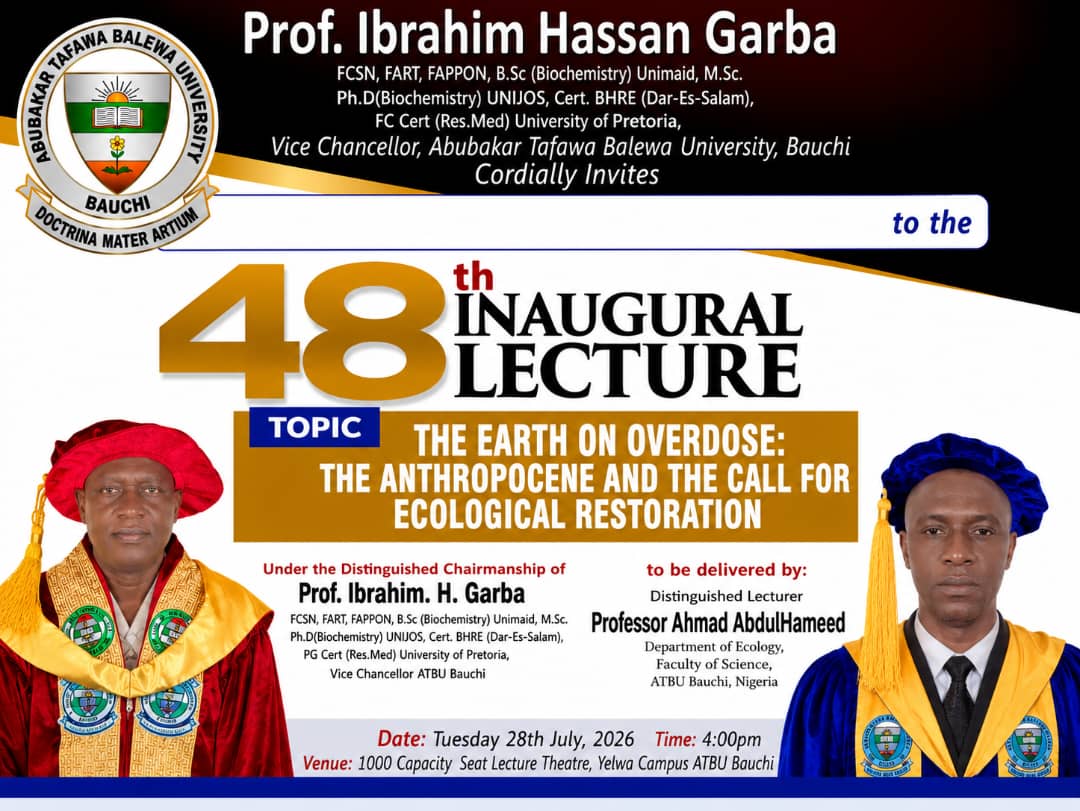
The Abubakar Tafawa Balewa University (ATBU), Bauchi, on Tuesday, 28th July 2026, hosted its 48th Inaugural Lecture at the University’s magnificent 1,000-Seater Lecture Hall, where renowned Professor of Ecology, Prof. Ahmad Abdulhameed, delivered one of the most significant lecture at this time where he titled it
“The Earth on Overdose: The Anthropocene and the Call for Ecological Restoration.”
The event attracted an impressive gathering of distinguished academics, researchers, government officials, security chiefs, university administrators, students, and invited guests from across Nigeria, which highlights the significance of the lecture and the growing concern over environmental degradation.
Among the notable personalities in attendance were the Vice-Chancellor of ATBU, Prof. Ibrahim Hassan Garba, the former Executive Secretary of the Tertiary Education Trust Fund (TETFund), Prof. Suleiman Elias Bogoro, the Deputy Vice-Chancellor (Academic), Prof. Sani Kunya, the Deputy Vice-Chancellor (Administration), the University Registrar, University Librarian, University Bursar, principal officers of the University, deans of faculties, heads of academic departments, scholars from various Nigerian universities, the Media and civil society groups, NGOs, the representative of Commandant of the 33 Artillery Brigade, the Commissioner of Police, Bauchi State, and several other dignitaries.
The inaugural lecturer was introduced and presented to the podium the Vice Chancellor himself, Prof. I. H Garba where he appreciated the initiative and sustainability of the inaugural lecture since its inception 21 years ago and praised the pioneer inaugural lecturer Prof. S. E Bogoro.
In his inaugural lecture, Prof. Ahmad Abdulhameed presented a compelling assessment of the current environmental crisis facing humanity. He described the Anthropocene, which is the current geological era dominated by human activities as a period in which the Earth has been subjected to unprecedented ecological stress through excessive exploitation of natural resources.
According to the Professor, unsustainable human activities have placed the Earth’s ecosystems under immense pressure, resulting in severe degradation of the soil, air, and water, with devastating consequences for agriculture, biodiversity, public health, and sustainable development.
He explained that widespread deforestation, pollution, industrial emissions, indiscriminate waste disposal, mining activities, poor agricultural practices, and rapid urbanization have accelerated environmental decline, contributing significantly to climate change, habitat destruction, loss of biodiversity, declining soil fertility, flooding, erosion, desertification, contamination of water bodies, and increasing incidences of environmentally related diseases, including cancer.
He insistsed that ecological restoration is the only way forward to get us out of this quackmire.
Prof. Abdulhameed emphasized that reversing the current environmental decline requires deliberate and science driven ecological restoration strategies.
He advocated for the large scale adoption of afforestation and reforestation programmes to restore degraded landscapes and improve carbon sequestration. He also highlighted the importance of bioremediation, a biological approach that employs microorganisms and plants to detoxify polluted soils and water bodies, as well as the application of biostimulants to improve soil health, enhance nutrient availability, and increase agricultural productivity in an environmentally friendly manner.
The Professor stressed that ecological restoration should not be viewed solely as an environmental responsibility but as a national development priority capable of improving food security, conserving biodiversity, reducing disaster risks, and enhancing human well-being.
He further urged governments, educational institutions, researchers, development partners, industries, and local communities to work collectively in restoring degraded ecosystems for the benefit of present and future generations.
Beyond the scientific discourse, the inaugural lecture also served as an opportunity for Prof. Abdulhameed to reflect on his remarkable academic journey spanning over 32 years.
He recounted his career progression from his appointment as a Graduate Assistant in 1993 to attaining the rank of Professor of Ecology sixteen years ago. Throughout his career, he has made significant scholarly contributions in the fields of Ecology, Biodiversity Conservation, Forestry, Wildlife Economy, Agroecology, Environmental Management, and Sustainable Natural Resource Conservation.
The Professor highlighted his numerous citations, peer reviewed journal publications in local and international numbering over 60, with visible research achievements, conference presentations, and collaborative projects that have contributed to advancing ecological science both within Nigeria and internationally.
Prof. Abdulhameed also outlined his numerous contributions to the growth and development of Abubakar Tafawa Balewa University.
He spoke extensively about his role in strengthening academic collaborations at local and international levels, mentoring young academics and researchers, and facilitating research partnerships that have enhanced the University’s visibility.
Among his notable achievements was his successful effort in securing funding opportunities for PhD researchers through collaborative programmes involving institutions in Aberdeen and Swansea in the United Kingdom, thereby expanding international research opportunities for ATBU scholars.
He reaffirmed his commitment to advancing research excellence, environmental sustainability, and capacity building within the University community.
Prof Abdulhameed ended his lecture by paying a special tribute to Prof. S.E Bogoro whom he described as a mental who is a beacon of Hope in Nigeria’s tertiary educational development and his contributions remains eternal.
The inaugural lecture was widely applauded by participants, who described it as both timely and intellectually enriching, particularly in light of the increasing global challenges posed by climate change, environmental degradation, and biodiversity loss.
In his closing remarks, the Deputy Vice-Chancellor (Academic), Prof. Sani Kunya, delivered the vote of thanks, expressing profound appreciation to the inaugural lecturer for his insightful presentation and lifelong contributions to ecological research and environmental sustainability.
He also thanked the Vice-Chancellor, invited guests, scholars, members of the University community, security agencies, and all participants for honouring the occasion and contributing to the success of the University’s 48th Inaugural Lecture.
With the vote of thanks, the curtains were officially drawn on the 48th Inaugural Lecture of Abubakar Tafawa Balewa University, Bauchi, leaving participants with a renewed commitment to promoting ecological restoration and environmental stewardship.
The 48th Inaugural Lecture reaffirmed Abubakar Tafawa Balewa University’s commitment to addressing contemporary global challenges through research, innovation, and public engagement. Prof. Ahmad Abdulhameed’s message served as a timely reminder that while human activities have placed the Earth under unprecedented ecological pressure, the future remains hopeful if governments, institutions, scientists, and citizens collectively embrace ecological restoration, sustainable resource management, and environmental conservation.

Kushi Libi Isaac
isaackushi99@gmail.com
Writes from Bauchi.
= 1140 ) { /* large monitors */ var adEl = document.createElement(“ins”); placeAdEl.replaceWith(adEl); adEl.setAttribute(“class”, “adsbygoogle”); adEl.setAttribute(“style”, “display:inline-block;width:468px;height:60px”); adEl.setAttribute(“data-ad-client”, “”); adEl.setAttribute(“data-ad-slot”, “”); (adsbygoogle = window.adsbygoogle || []).push({}); } });window.addEventListener(“load”, function(){ var placeAdEl = document.getElementById(“td-ad-placeholder”); if ( null !== placeAdEl && td_screen_width >= 1019 && td_screen_width = 768 && td_screen_width < 1019 ) { /* portrait tablets */ var adEl = document.createElement("ins"); placeAdEl.replaceWith(adEl); adEl.setAttribute("class", "adsbygoogle"); adEl.setAttribute("style", "display:inline-block;width:468px;height:60px"); adEl.setAttribute("data-ad-client", ""); adEl.setAttribute("data-ad-slot", ""); (adsbygoogle = window.adsbygoogle || []).push({}); } });window.addEventListener("load", function(){ var placeAdEl = document.getElementById("td-ad-placeholder"); if ( null !== placeAdEl && td_screen_width