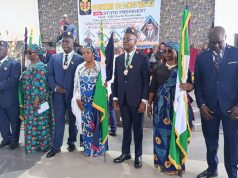
The Plateau State Peace Building Agency (PSPBA) has reaffirmed its commitment to promoting a coordinated and sustainable peace agenda through the integration of humanitarian, development, and peacebuilding initiatives across Plateau State.
This renewed commitment was emphasized during the Plateau Peace Architecture Forum (PPAF) held at FOX Hotels, Jos, which convened policymakers, peace practitioners, humanitarian actors, and development partners in a united effort to strengthen resilience and foster lasting peace across the state.
The forum, themed “Integrating the Humanitarian-Development-Peace (HDP) Nexus for Sustainable Impact in Plateau State,” provided a collaborative platform for participants to enhance coordination, share experiences, and build strategic partnerships for greater impact.
Declaring the event open, Dr. Julie G. Sanda, Director General of the Plateau Peace Building Agency, reiterated the agency’s core mandate of coordinating peacebuilding efforts that address real-time community needs. She stressed that peace cannot be sustained without linking it to social and economic recovery, adding that the HDP framework provides a holistic pathway for addressing post-conflict challenges across the state.
“Peace cannot thrive in isolation from development and humanitarian action,” Dr. Sanda said. “For Plateau to remain at peace with itself and others, we must build deliberate partnerships that connect trauma healing, livelihood restoration, education recovery, and community resilience.”
In her presentation titled “Reflections from the September HDP Nexus Workshop Proceedings – Lessons and Highlights,” Dr. Sanda explained that the agency’s coordination role extends beyond peace mediation to partnerships in education, child protection, emergency management, and sustainable development goals (SDGs). She emphasized that genuine peacebuilding requires multi-sectoral collaboration that empowers communities to recover, rebuild, and sustain progress.
Delivering goodwill messages, Hon. Sam Godong, Director General of the Research Directorate in the Plateau State Government House, described the forum as a timely initiative aligned with the state’s broader governance agenda for peace, security, and development. Similarly, Dr. Tanko Davit of the National Institute for Policy and Strategic Studies (NIPSS) commended PSPBA’s leadership, noting that the Plateau peace model is now influencing similar initiatives in neighboring Nasarawa State.
Mr. Brandon Fantis of the Centre for Humanitarian Dialogue (CHD) praised the agency’s coordination efforts and called for stronger collaboration among humanitarian and development partners. He stressed that joint learning and partnerships remain essential for sustaining peace dividends.
Representing the House Committee on Labour and Security, Mr. Mafeng Bot, who stood in for Hon. Joe Bukar, applauded PSPBA’s proactive role in convening the dialogue and encouraged continuous synergy among stakeholders to promote durable peace and inclusive development.
In his remarks, Nanman Bali, President of the Plateau Peace Practitioners Network, described the forum as a groundbreaking space linking humanitarian work with peacebuilding. He noted that the engagement offered practitioners a unique opportunity to exchange ideas, share experiences, and strengthen coordination for sustainable results.
Delivering the keynote address titled “Operationalising the HDP Nexus in Plateau State: Pathways and Possibilities,” Mr. John Danboyi of the Peace Training Centre highlighted the importance of people-centered approaches and institutional collaboration. He emphasized that sustainable peace depends on inclusive governance, resilient communities, and consistent investment in peace-supportive development initiatives.
A panel session moderated by Mr. Nantip, on “Integrating the HDP Nexus into Programme Design and Implementation,” featured panelists from PLASEMA, NRC, JDPC, CRADI, the SDGs Office, and the Child Protection Network. Discussions focused on enhancing coordination among HDP actors, strengthening community participation, and ensuring transparency and measurable outcomes in project delivery.
Participants also took part in fish-bowl breakout sessions covering three key thematic areas:
- Displacement, Shelter & Host Communities
- Food Security, Livelihood & Nutrition
- Education in Emergencies & Peace-Humanitarian Nexus
The sessions revealed persistent challenges such as high school dropout rates, overstretched host communities, inadequate learning facilities, and declining agricultural productivity — issues closely tied to conflict and climate-related shocks.
Stakeholders recommended increased education funding, improved teacher welfare, community-based support for displaced persons, and livelihood empowerment programs to strengthen food systems and restore sustainable education and housing solutions.
In conclusion, participants jointly reaffirmed their commitment to deepening collaboration and fully operationalizing the HDP Nexus as a practical roadmap for achieving sustainable peace, resilience, and inclusive development in Plateau State.
The Plateau Peace Architecture Forum (PPAF) stands as a strong testament to PSPBA’s leadership and vision promoting an integrated approach to peacebuilding that connects humanitarian response, development recovery, and enduring peace for the prosperity of Plateau’s communities.